Physical AI deployment company

Making robots work in production.

Advaitic deploys model-powered robotics into messy real-world workflows where foundation models almost work, but still fail too often for production.

Robotics workcell with a manipulator arm in a lab environment
Deployment surface High-variance manipulation workflows
Product wedge Digital twin, edge runtime, observability, learning loop
Starting point Book logistics and electronics test benches
Thesis

We are the independent deployment layer between fast-moving robot foundation models and the operators who need reliable physical work done on site.

§ 01 Product

A deployment stack for physical AI systems.

Customers pay for outcomes: robots that can handle useful work under real site variation. We stitch together best-in-class models, simulation, hardware, and monitoring instead of asking customers to bet on one vendor.

01

Digital twin pre-deployment

Scan the facility, recreate the task environment, and validate policies before hardware blocks production flow.

02

Model-agnostic policy serving

Evaluate and route across foundation models, classical controls, and task-specific policies without customer lock-in.

03

On-device inference

Run low-latency perception and control on edge compute where cloud-only inference is too slow or sensitive.

04

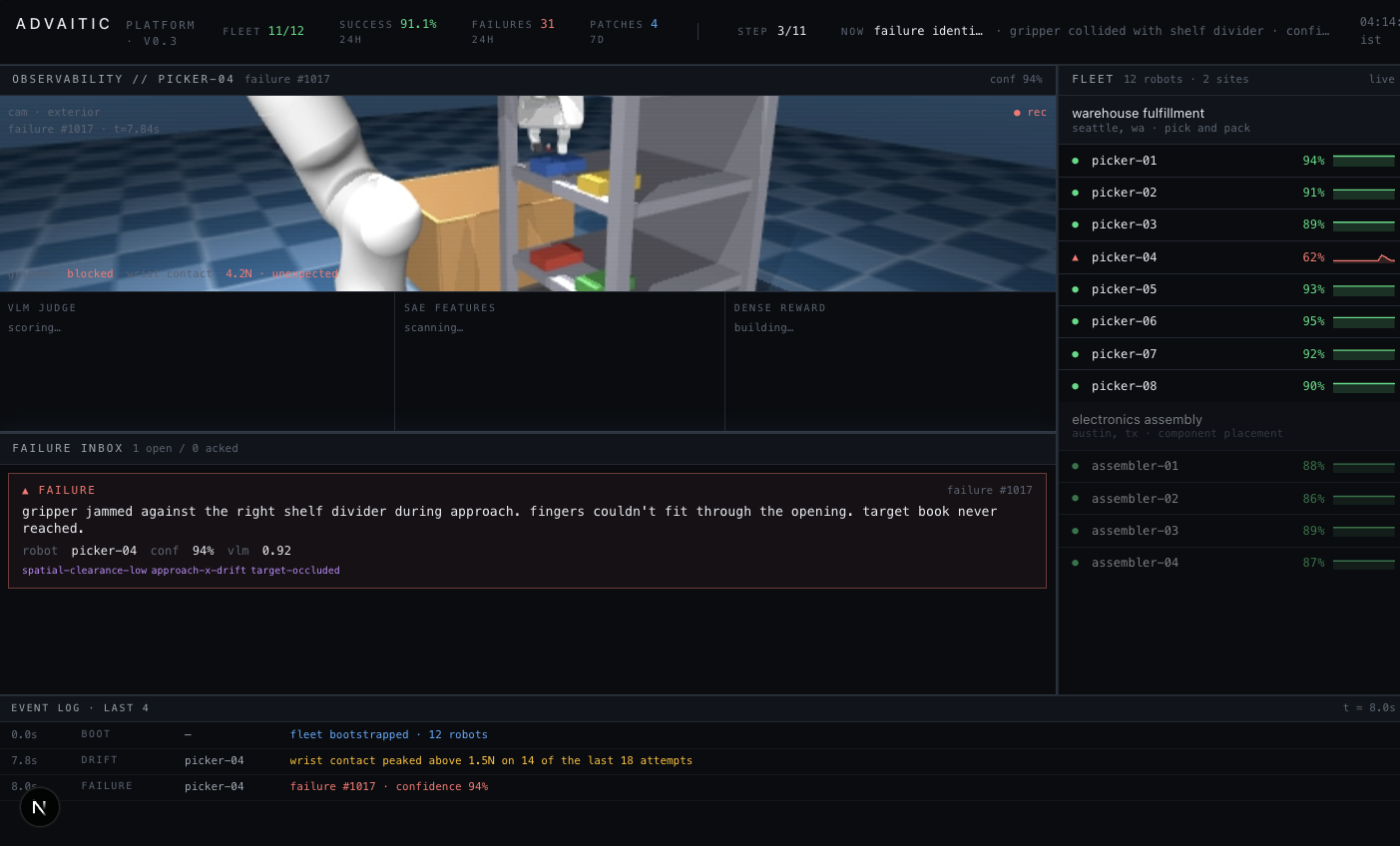
Operations observability

Track failures, interventions, recovery paths, and production metrics so reliability improves after deployment.

§ 02 Why now

Reliability at scale is the bottleneck.

Robot foundation models, cameras, manipulators, and simulation are improving quickly. The remaining gap is production reliability across every customer, workflow, object variation, edge case, and recovery path.

Task chains 95% per-step success can collapse across a chained physical task.
Operator trust 99%+ per-step reliability is what operators need before automation becomes trusted infrastructure.
Runtime 24/7 production cells need monitoring, rollback, human review, and continuous post-deployment learning.

§ 03 Deployment playbook

From messy workflow to operating cell.

  1. Map

    Find the repeatable pain

    Document materials, throughput targets, exception rates, safety boundaries, and human handoffs.

  2. Simulate

    Build the site twin

    Use scans, procedural variants, and task data to test policies before they touch the real workflow.

  3. Deploy

    Run a bounded pilot

    Integrate manipulators, sensors, edge compute, classical controls, and learned policies on site.

  4. Improve

    Compound failure data

    Capture interventions and outcomes, then improve models and procedures with human-approved updates.

§ 04 Use cases

Starting where classical automation is too rigid.

We start with high-variance workflows where the environment shifts, recovery paths matter, and useful automation still depends on adapting to the messiness of the real world.

01

Chaotic operating environments

Workcells with changing objects, layouts, lighting, and handoffs where fixed programs break under day-to-day variation.

02

High-precision physical tasks

Manipulation and inspection steps where small errors compound quickly and reliability matters more than a polished demo.

03

Lab and industrial automation

Structured but evolving workflows that still require flexible perception, recovery logic, and human-aware deployment in production.

§ 05 Work with us

Bring us the workflow your current automation cannot handle.

We are looking for design partners with real operational pain, measurable throughput goals, and teams ready to pilot physical AI in the field.

hello@advaitic.ai